
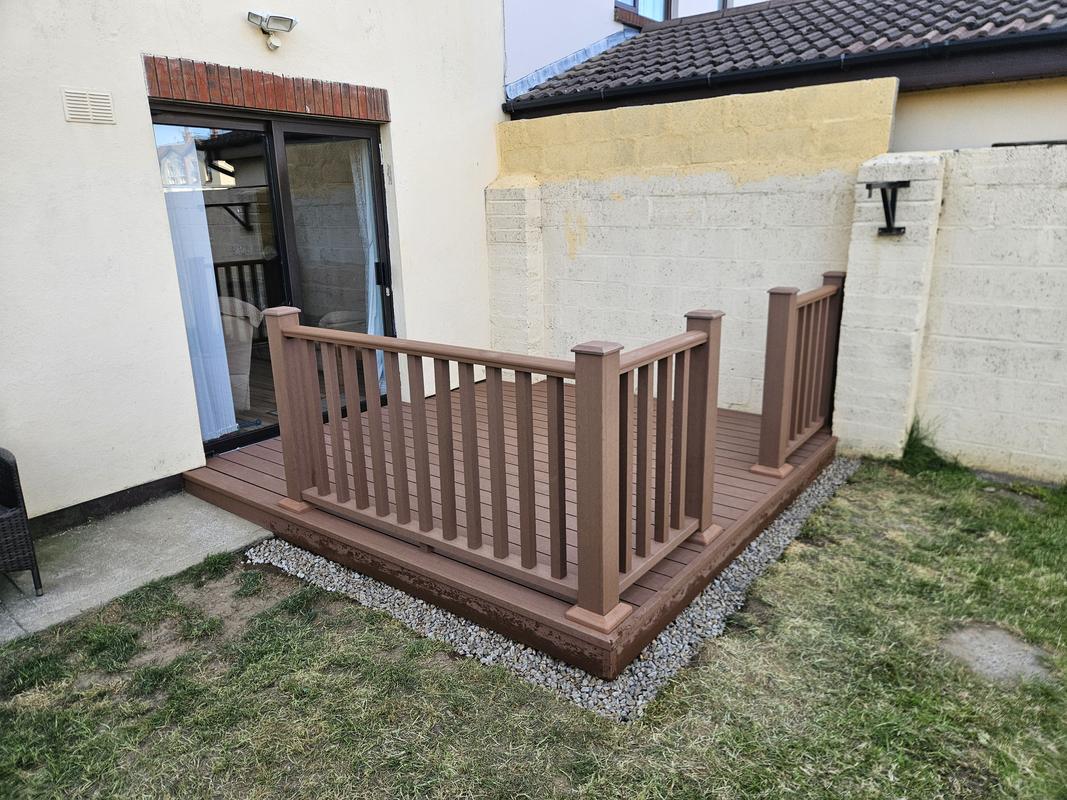
If you have started gathering quotes, the figures may have given you a fright. A common story on Irish forums goes something like this: a homeowner asks about a 23m² composite deck with a railing, gets quoted close to ten grand, and wonders if they are being taken for a ride. Some of those quotes are fair, some are not, and the only way to tell is to understand what composite decking actually costs in Ireland in 2026 and what should be in the price. This guide gives you indicative supply-and-fit ranges for planning a County Louth project, the things that push the price up, and how to read a quote so you are not caught out.
Pricing basis: These are indicative planning ranges using our decking cost hub, not a fixed offer or a completed-project price. They assume a straightforward ground-level deck with reasonable access, boards, a basic subframe, fixings and labour. Steps, railings, lighting, major groundwork and removal are itemised separately. Confirm VAT treatment and the final total in your written quote before comparing prices.
Composite Decking Cost Per Square Metre in Ireland (2026)
Decking is priced per square metre for supply and install, including the subframe. That all-in figure is the number to compare between quotes, not the price of the boards on their own, which is where a lot of confusion starts. A board you see online for €55 a metre is just the timber sitting in a yard. It does not include the frame, the fixings, the labour, or the cleanup. A full composite decking supply and fit price wraps all of that into one figure.
These indicative ranges match our cost hub for the same basic ground-level specification:
| Composite type | Cost per m² (supply and fit, inc. subframe) |
|---|---|
| Standard capped composite | €190 to €250 |
| Premium capped composite | €250 to €325 |
A word on the very cheap boards. You will find flat-pack composite advertised far below these figures. It tends to be thin, uncapped and prone to fading and staining, and it is a false economy on a deck you want to last twenty-five years. We do not fit it, and we would tell you straight if a quote that looks too good to be true is built on it. If you want the wider picture across timber and composite, our decking pricing guide sets out every material side by side.
What a 20m² Composite Deck Costs in a Louth Back Garden
A 20m² footprint is a useful calculated example, rather than a claim about a typical completed job. For a straightforward ground-level or low-level deck, no steps, no handrails, reasonable access:
- Standard composite: roughly €3,800 to €5,000
- Premium capped composite: roughly €5,000 to €6,500
That is the bare deck. The moment you add steps, a raised section or a railing, the figure climbs, which brings us neatly to the part of a quote that catches people out.
What’s Included, and What Costs Extra
This is where the ten-grand quotes come from, and where an honest quote earns its keep. A proper supply-and-fit price should already include the subframe, the boards fastened and finished, a weed membrane underneath, and a basic cleanup. What is almost always priced separately:
- Steps. These are labour-heavy and add roughly €300 to €800 per step run depending on width and material.
- Handrails and balustrades, especially on anything raised.
- Integrated lighting run into the boards or risers.
- Skirting or fascia to close off the perimeter.
- Removal and disposal of an old deck, which takes time and a skip.
None of this is a hidden cost when it is itemised up front. It only becomes one when a vague quote leaves it out and it reappears at the end. We list every line so the price you hear is the price you pay, and we itemise removal and disposal when replacing an old deck. For the full rundown on the extras that quietly inflate a bill, see our guide to the extras that should already be in your decking quote.
Why Composite Costs More Than Timber Upfront, and Less Over Time
There is no getting around it: composite costs more on day one. Pressure-treated softwood comes in lower per square metre, which is why a lot of people start there. The honest comparison is not the upfront figure, it is what you spend over the life of the deck.
A timber deck needs a clean and a fresh coat of oil or stain every year or two to stop it greying, cracking and going slippery in our damp climate. Over twenty years that adds up in both money and weekends. Composite needs regular cleaning, especially in shaded or damp areas, following the specified manufacturer’s instructions. It generally avoids routine oiling and staining. Warranty duration, exclusions and whether labour is covered depend on the exact product and installation.
So composite is dearer to buy and cheaper to own. For most gardens in County Louth, particularly north or east-facing ones that get less sun and stay damp longer, it works out the better value once maintenance is in the sum. That is value over time, not the cheapest sticker price, and it is the call we would make in our own gardens.
What Moves the Price Up or Down
Two identical-sized decks can be priced very differently, and for good reason. The main factors:
- Size and shape. A simple rectangle is the most cost-effective deck to build. Curves, angled boards, notching around posts and multi-level designs all take more time per square metre.
- Height and slope. A ground-level deck on flat ground is straightforward. A raised deck on a sloped garden needs more framing, longer posts and sometimes bracing, all of which add up.
- Access. Carrying materials through the house or down a narrow side passage, or nowhere to park the van, all add labour.
- Ground preparation. Levelling, drainage or digging out an old slab is extra groundwork before a board goes down.
- Planning. Planning and edge-protection requirements depend on the site, height and design. For a raised deck, overlooking or a protected property, confirm requirements with Louth County Council and an appropriately qualified designer before starting; do not assume a single height threshold makes a design exempt or safe.
How to Sense-Check a Quote in County Louth
If you take one thing from this, make it this: get every quote itemised, and compare the all-in per-square-metre figure, not the headline total. A €4,000 quote with steps, a rail and removal included can be far better value than a €3,200 quote that turns into €4,500 once the extras land.
When we quote a deck in Dundalk, Blackrock, Carlingford or anywhere across the county, we put the board, the frame, the steps, the lighting and the cleanup on separate lines, and required old-deck removal is itemised in the price. You see exactly what you are paying for and where, which makes it easy to hold any other quote up against it. That is the difference between a local team you can ring and a number pulled out of the air.
We do not put a flat figure online because no two gardens are the same, and a real price needs a real look at the job. What you will get from us is a free, written, itemised quote with old-deck removal itemised where required and no surprises at the end. Get your free decking quote, call Seamus on 085 168 5170, or send a message on WhatsApp, and he will call out to measure up and price it properly.